
Building a Strong Foundation: IT Infrastructure and Local SEO

The Core Pillars of Small Business Digital Growth
In July 2026, the landscape for small businesses has transformed dramatically. The digital realm is no longer just a marketing channel; it’s the core of customer interaction and growth. With AI-powered search engines like Google AI Mode and Gemini now shaping how customers find services, establishing a robust online presence is not just an advantage—it’s essential for survival.
Many local service businesses, however, struggle to navigate this complex environment. They face challenges like fragmented digital tools and difficulty generating quality leads. We understand these hurdles. Our goal in this guide is to simplify the path to sustainable Small Business Digital Growth.
We will explore how building a solid IT infrastructure works hand-in-hand with optimizing your local search presence. From securing your digital assets to leveraging local SEO and advanced tactics like digital growth link building for small businesses, we’ll show you how to create a connected system. This approach ensures your business is visible, efficient, and ready to capture customers at every stage of their journey.
For small businesses in 2026, digital growth is no longer optional; it’s a fundamental requirement for staying competitive. This necessity stems from shifting consumer behaviors, technological advancements, and the pervasive integration of digital tools into daily operations. We’ve seen a significant acceleration in digital adoption, with 75% of small businesses now incorporating digital tools into their daily operations, and a remarkable two-thirds emphasizing the importance of a seamless digital experience for their success. This digital transformation means moving beyond basic online presence to building a comprehensive, interconnected ecosystem that supports every aspect of customer acquisition and retention.
The journey to effective digital growth begins with a robust IT infrastructure. This isn’t just about having computers and internet; it’s about the underlying systems that enable your digital marketing, customer management, and data security. A well-planned IT strategy is the backbone of all successful digital initiatives, ensuring reliability, scalability, and efficiency. For many small businesses, navigating this can be complex, often leading to fragmented tools and missed opportunities. Understanding and implementing sound IT practices is crucial for unlocking your full digital potential. You can find comprehensive resources and support for structuring your digital backbone at IT for Small Business Digital Growth.

Overcoming Platform Fragmentation
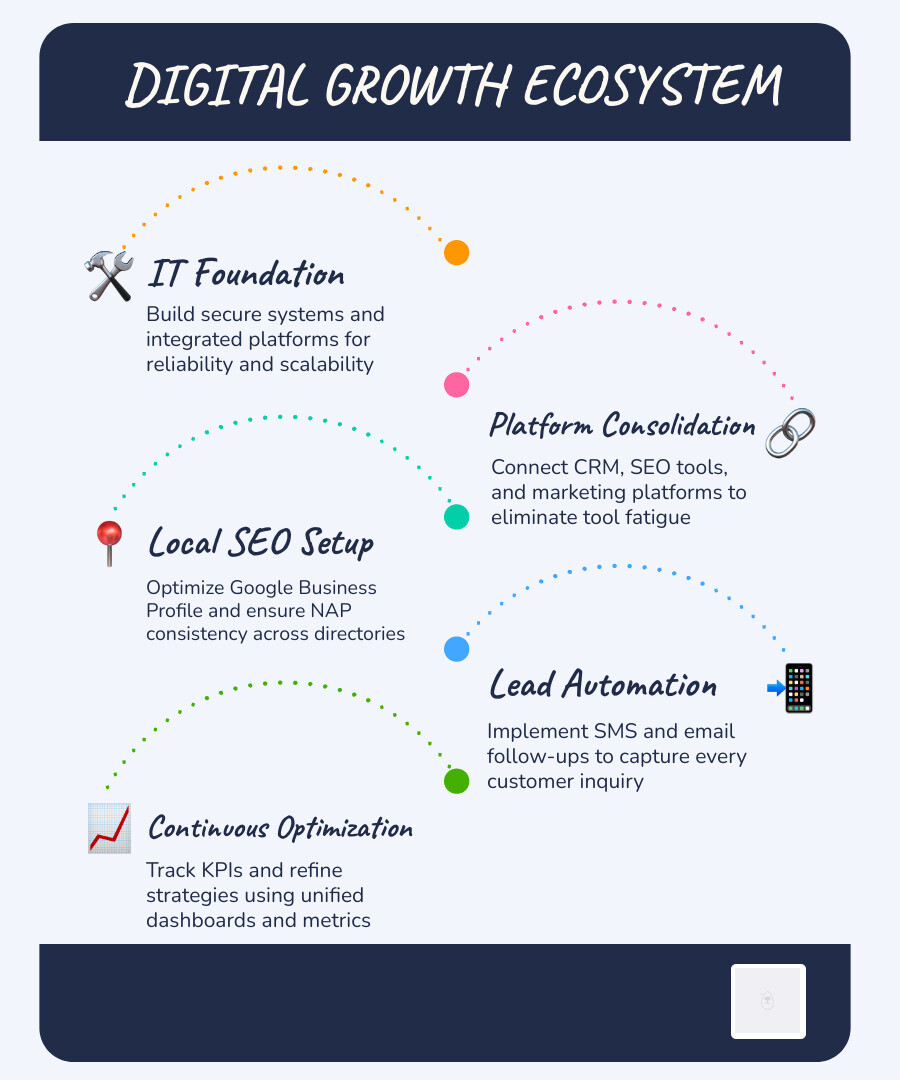
A challenge small businesses face in their digital growth journey is platform fragmentation. Many find themselves overwhelmed by managing more than six different platforms each day, leading to what we call “tool fatigue.” This scattered approach often results in lead leakage, poor tracking, and an inability to get a holistic view of marketing performance.
To counter this, we advocate for platform consolidation and integration. This involves connecting disparate systems like your website, SEO tools, advertising platforms, Customer Relationship Management (CRM) software, and marketing automation tools into a cohesive whole. For instance, CRM automation can streamline lead capture, nurturing, and conversion, ensuring that no potential customer falls through the cracks. Unified dashboards provide a single source of truth, allowing us to track key metrics and identify areas for improvement without juggling multiple logins and reports. This integrated approach not only boosts efficiency but also provides deeper insights into the customer journey, from initial contact to conversion and retention.
Protecting Your Digital Assets
As small businesses increasingly rely on digital tools, protecting their digital assets becomes paramount. The unfortunate reality is that over 40% of cyberattacks in 2023 were directed at small businesses, often because they are perceived as easier targets due to limited resources for cybersecurity. The consequences can be devastating, with around 60% of small businesses that experience a cyberattack going out of business within six months.
Effective cybersecurity is therefore a non-negotiable component of digital growth. This includes implementing strong passwords, multi-factor authentication, regular software updates, and robust backup solutions. Beyond technical measures, it also involves establishing clear data privacy policies, ensuring compliance with regulations, and training employees on best practices to prevent breaches. Proactive risk management and a solid business continuity plan are essential to safeguard your operations, customer data, and reputation in the digital age. Investing in these areas protects your growth trajectory and builds trust with your customer base.
Merging IT Infrastructure with Local Search Visibility
With a solid IT foundation in place, the next critical step for small businesses, especially local service providers, is to dominate local search visibility. In 2026, 98% of consumers use the internet to find information about local businesses, making local SEO and Google Business Profile (GBP) optimization more crucial than ever. A complete and actively managed GBP can make a business 2.7 times more likely to be viewed as reputable. This goes beyond just having a listing; it involves consistent Name, Address, and Phone (NAP) information across all online directories, high-quality photos, regular posts, and proactive review management.
Website performance also plays a significant role. Google’s Core Web Vitals continue to influence search rankings, emphasizing page speed, responsiveness, and visual stability. A slow or clunky website can deter potential customers, regardless of how well you rank. Furthermore, integrating schema markup—structured data that helps search engines understand your content—is vital for local businesses, signaling specific services, business hours, and location data directly to search algorithms. For enhancing your local search presence and overall online authority, exploring strategies for improving your digital footprint, such as those related to link building, can be highly beneficial.

Optimizing for the Modern Search Landscape
The advent of AI-powered search, epitomized by Google AI Mode and Gemini, has fundamentally reshaped how small businesses must approach visibility. The search bar now often answers questions conversationally before showing traditional links, and AI agents are increasingly comparing and booking services on behalf of customers. This shift introduces a new frontier: Generative Engine Optimization (GEO).
GEO is about structuring your content so that AI models can easily extract clean, accurate answers and cite your business as a source. This means moving beyond keyword stuffing to focusing on search intent, providing clear, concise answers to common questions, and optimizing for entity recognition. For local service businesses, this presents a unique opportunity. While AI excels at generic queries, it often struggles with hyper-local, current, or nuanced questions. By providing detailed, location-specific content, small businesses can position themselves as the authoritative source for AI-driven local searches. This involves using clear question-style headings, short extractable sections, FAQ blocks, and robust schema markup to ensure your content is machine-readable and AI-friendly.
Maximizing Conversion with Automated Follow-Up
Capturing a lead is only half the battle; converting it requires timely and effective follow-up, an area where many small businesses still struggle. Lead leakage and slow response times are common culprits. This is where marketing automation, particularly AI-powered tools, becomes invaluable.
Missed-call text-back systems ensure that no inquiry goes unanswered, immediately engaging potential customers even if you’re unavailable. SMS automation can nurture leads with relevant information, appointment reminders, or special offers, leveraging the high open rates of text messages. Email marketing, which still boasts an impressive average return of $36 for every $1 spent, can be automated to send personalized sequences that guide prospects through the sales funnel. By integrating these tools with your CRM, we can ensure a seamless flow of communication, drastically reducing lead response times and significantly improving conversion rates. AI-driven follow-up can personalize interactions at scale, making customers feel valued without requiring constant manual oversight, thus boosting conversion rates without losing authenticity.
Strategic Resource Allocation and Execution
Making informed decisions about where to invest limited resources is critical for small businesses. When it comes to digital marketing, the choice often boils down to doing it yourself, hiring an agency, or opting for a done-for-you service. Each approach has its merits and drawbacks, depending on your budget, time, and expertise.
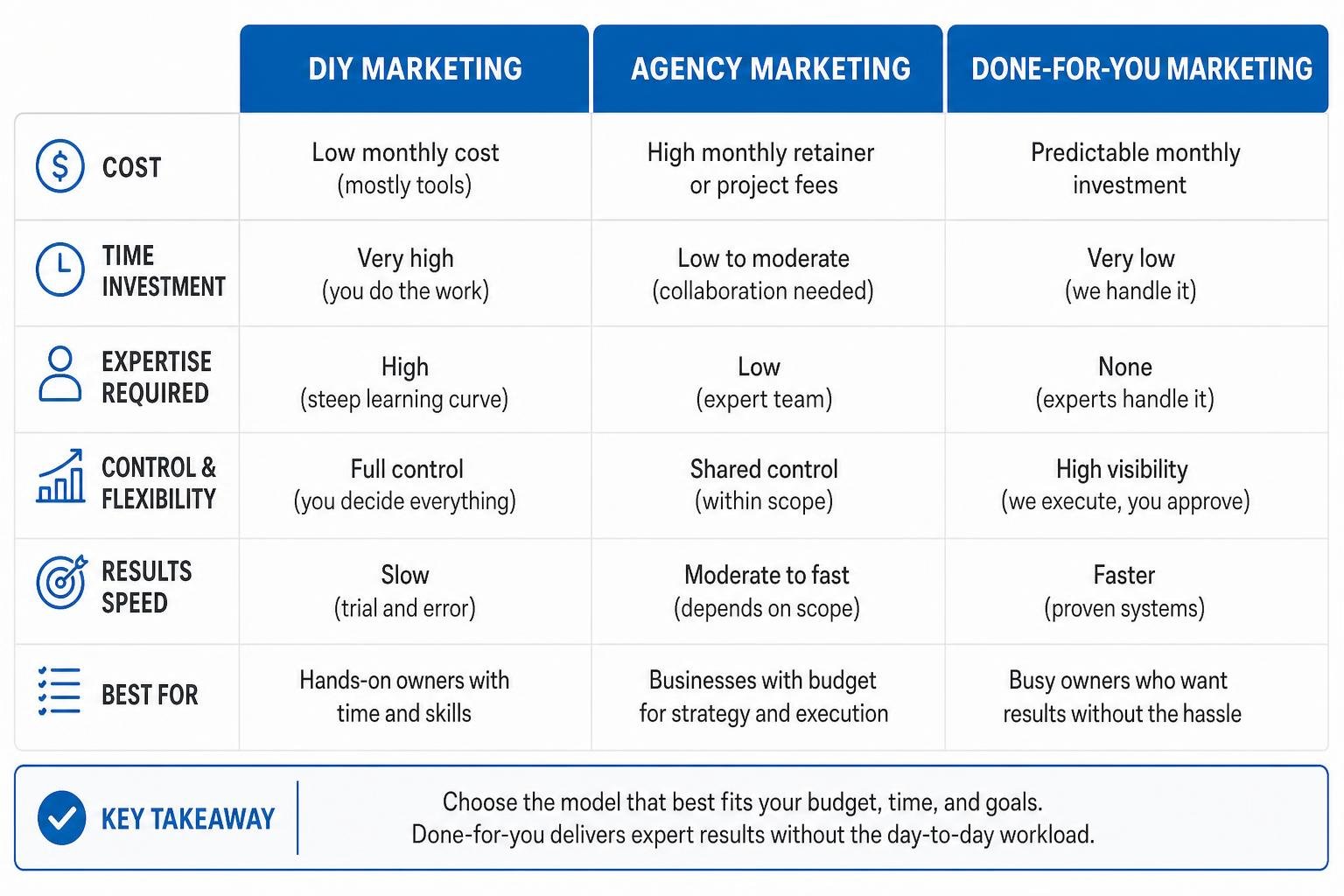
DIY marketing can be cost-effective initially but demands significant time and a steep learning curve. Hiring an agency offers expertise but typically comes with a higher price tag. Done-for-you services, like our connected growth system, aim to strike a balance, providing expert execution without the burden of day-to-day management for the business owner.
Budget allocation is another key consideration. We often recommend the 70/20/10 rule: 70% of your budget goes to proven strategies, 20% to promising new ideas, and 10% to experimental tactics. This balanced approach ensures stable growth while allowing for innovation. Tracking ROI is paramount, focusing on key performance indicators (KPIs) like customer acquisition cost (CAC), customer lifetime value (CLTV), leads generated, and conversion rates, rather than vanity metrics. Email marketing, for example, consistently delivers high ROI, averaging $36 for every $1 spent. While paid ads can generate leads within days, SEO and content marketing typically require 3-6 months to show significant results, underscoring the need for patience and a long-term perspective.
The 90-Day Digital Growth Roadmap
A structured plan is essential for effective digital growth. Here’s what a practical 90-day roadmap looks like for a local service business:
Days 1-30: Fix the Foundation This initial phase focuses on establishing a strong, conversion-optimized base.
- Website Audit & Optimization: Ensure your website is fast, mobile-friendly, and has clear calls to action. Implement essential technical SEO elements and schema markup.
- Google Business Profile (GBP) Optimization: Claim, verify, and fully optimize your GBP with accurate information, services, photos, and initial posts. Encourage initial reviews.
- Customer Persona Development: Clearly define your ideal customer to tailor all marketing efforts effectively.
- Conversion Tracking Setup: Implement robust analytics (e.g., Google Analytics 4) and conversion tracking across your website and GBP to measure leads and actions.
Days 31-60: Build the Engine With the foundation set, this phase focuses on actively generating leads and building your content engine.
- Local SEO & Content Strategy: Begin creating localized content that answers customer questions and targets intent-rich keywords. Focus on building authority within your service area.
- Paid Advertising Launch (Google Ads/Meta Ads): Start with targeted campaigns for immediate lead generation. Begin with a smaller budget, testing different ad creatives and keywords.
- Email List Building: Implement lead magnets on your website to start growing your email list.
- Review Management System: Systematize requesting reviews from happy customers and responding to all feedback promptly.
Days 61-90: Measure, Double Down, Repeat This phase is about analyzing performance, optimizing, and scaling what works.
- Performance Review: Analyze data from all channels (website, GBP, ads, email). Identify top-performing keywords, ad creatives, and content.
- Optimization: Reallocate budget to best-performing campaigns. Refine ad targeting, improve website conversion paths, and optimize content for better AI visibility.
- Automation Implementation: Set up or refine email/SMS automation for lead nurturing and missed-call follow-up.
- Scaling: Based on successful strategies, plan to incrementally increase investment in channels delivering the highest ROI. Focus on continuous improvement and adapting to new AI search trends.
Frequently Asked Questions About Small Business Digital Growth
How long does it take to see results from digital growth initiatives?
The timeline for seeing results varies significantly across different digital channels. Paid advertising, such as Google Ads or Meta Ads, can generate leads and traffic within days or weeks of launch. Email marketing can show results within 1-2 months, especially once an engaged list is established. However, organic strategies like SEO and content marketing typically require a longer commitment, usually taking 3-6 months to show meaningful improvements in rankings and organic traffic. Building a strong online reputation through review management is an ongoing process that yields cumulative benefits over time. Patience and consistent effort are key, especially for long-term strategies.
What is the difference between traditional SEO and Generative Engine Optimization?
Traditional SEO primarily focuses on optimizing websites to rank higher in traditional search engine results pages (SERPs) for specific keywords. This involves on-page optimization, technical SEO, link building, and content creation aimed at Google’s ranking algorithms.
Generative Engine Optimization (GEO), on the other hand, is a newer discipline emerging with the rise of AI-powered search engines like Google AI Mode, Gemini, and platforms like ChatGPT. GEO focuses on structuring content so that Large Language Models (LLMs) can accurately extract information and cite your business in their AI-generated answers. This involves optimizing for clear, concise answers to user questions, entity optimization, and specific schema markup that helps AI understand your content’s context and relevance. While traditional SEO aims for clicks to your website, GEO aims for your business to be the authoritative answer cited directly by AI, influencing user decisions even without a direct website visit. We see GEO as a crucial layer built upon a strong SEO foundation.
How can a small business secure its digital infrastructure on a budget?
Securing your digital infrastructure doesn’t have to break the bank. Start with fundamental, low-cost measures:
- Strong Passwords & Multi-Factor Authentication (MFA): Enforce complex passwords and enable MFA for all accounts. This is a simple yet highly effective deterrent.
- Regular Software Updates: Keep all operating systems, applications, and plugins updated. Updates often include critical security patches.
- Cloud Backup Solutions: Utilize affordable cloud services for regular data backups. This protects against data loss from cyberattacks or hardware failures.
- Employee Training: Educate your team on cybersecurity best practices, identifying phishing attempts, and safe browsing habits. Human error is often a primary vulnerability.
- Basic Firewall & Antivirus: Ensure all devices have up-to-date antivirus software and a properly configured firewall.
- Secure Wi-Fi: Use strong encryption (WPA2 or WPA3) for your business Wi-Fi network.
- Limit Access: Grant employees access only to the systems and data they need for their roles.
While these steps are budget-friendly, they form a robust first line of defense. As your business grows, consider investing in more advanced solutions like professional IT support or managed security services.
Charting Your Path to Sustainable Digital Expansion
The digital landscape for small businesses in July 2026 is dynamic and full of opportunity. While the shift to AI-powered search and the complexities of integrated digital systems present new challenges, they also offer unprecedented avenues for growth. By focusing on a connected digital growth system—one that seamlessly integrates a robust IT infrastructure with cutting-edge local SEO and AI-driven strategies—small businesses can not only survive but thrive.
Our journey through the core pillars of digital growth, the synergy between IT and local search, and strategic resource allocation underscores a critical truth: sustainable growth is about more than just marketing tactics. It’s about building a resilient, adaptable, and efficient digital ecosystem. Continuous optimization, driven by data and responsive to evolving technologies, will ensure your marketing efforts are not just effective today but scalable for tomorrow. By embracing technology adoption and prioritizing long-term ROI, we can chart a clear path towards sustained digital expansion, ensuring your business remains visible, competitive, and profitable for years to come.

