
The Tech Behind Modern Aluminum Floating Dock Engineering
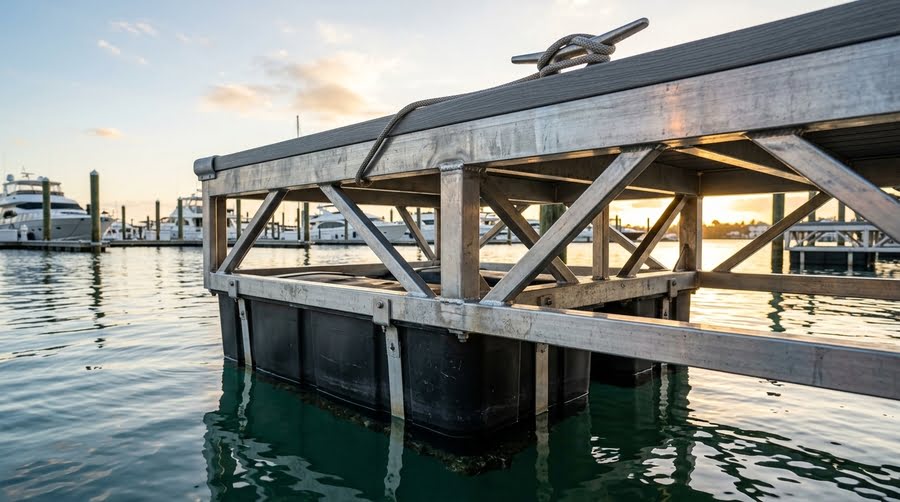
Modern floating docks may look fairly simple from the shoreline, but a lot of engineering goes into keeping them stable, usable, and durable around moving water. Aluminum framing, specialized flotation, connection systems, decking, and anchoring all have to work together. For property owners comparing dock systems, understanding these components makes it easier to see why construction quality matters beyond appearance.
Marine-Grade Aluminum Alloys (6061-T6 and 5052)
Aluminum alloys such as 6061-T6 and 5052 are commonly used in marine fabrication because they combine relatively low weight with useful strength and corrosion resistance. They aren’t interchangeable, though. Different alloys have different forming, welding, and structural characteristics, so builders select material according to the job each component has to perform.
For an aluminum floating dock, that can mean using structural shapes where stiffness is needed while selecting more formable material for certain fabricated parts. The result depends just as much on proper design and fabrication as it does on the alloy designation itself.
TIG and MIG Robotic Welded Frameworks
Weld quality has a major influence on an aluminum frame. MIG and TIG processes are both used in aluminum fabrication, with the appropriate method depending on material thickness, joint design, production needs, and the level of control required.
Some manufacturers also use automated or robotic welding for repeatable frame components. Consistent weld placement can help maintain uniform construction across multiple sections. Still, automation isn’t a substitute for good joint preparation, sound engineering, or final inspection.
Rotomolded Polyethylene Float Drums with EPS Foam Core
The flotation beneath a dock does more than keep the deck above water. Float position affects freeboard, balance, and how the structure responds as people move across it.
Rotomolded polyethylene float drums are used on many floating dock systems because the molded outer shell can tolerate regular marine exposure. Some designs incorporate expanded polystyrene foam within the float. The exact configuration varies by manufacturer, so buyers should ask how flotation units are constructed, supported, attached, and replaced if one becomes damaged.
Heavy-Duty Internal Track and Channel Systems
Track and channel systems can give a dock frame more flexibility during fabrication and installation. Rather than drilling new attachment points for every accessory, an integrated channel may provide designated locations for hardware, brackets, bumpers, or other components.
For floating dock builders, this type of framework can also make future changes easier to plan. Owners may decide later to adjust a slip, add an accessory, or alter access. A well-designed attachment system can reduce the amount of modification required to the main frame.
Advanced Silent Extruded Hinge Systems
Connections between floating sections need movement. If two dock modules were joined rigidly, waves and shifting loads could place considerable stress on the connection.
Extruded hinge systems are designed to let connected sections articulate while maintaining alignment. Designs intended to reduce metal-on-metal movement can also help limit unwanted noise at the joint. Buyers comparing aluminum docks should look closely at how hinge components are supported and how easily wear points can be inspected.
Integrated Self-Mating Interlocking Decking Panels
Decking contributes to more than the dock’s finished appearance. It affects drainage, footing, maintenance, and how the walking surface ties into the frame.
Interlocking aluminum panels can create a closely fitted surface while reducing the number of loose individual boards. Some systems use profiles that mate together during installation, helping maintain straight lines across the deck. A boat dock builder still has to account for fastening, expansion, edge treatment, and the way decking meets ramps or other transitions.
Dynamic Articulating Anchor and Piling Guides
A floating structure has to stay in position while remaining free to respond to changing water conditions. That balance makes anchoring one of the more technical parts of dock design.
Articulating anchor connections and piling guides allow controlled movement rather than trying to hold the dock completely rigid. The appropriate approach depends on water depth, bottom conditions, wave exposure, and seasonal changes. This is one reason aluminum boat docks for sale should be evaluated as complete systems rather than isolated platforms.
When it comes to modern aluminum floating dock engineering, you can rely on Flotation Systems Inc. for consistent stability and balanced weight distribution. Their systems typically utilize heavy-duty, rotationally molded polyethylene shells filled with expanded polystyrene (EPS) foam to ensure the structure stays afloat even if a puncture occurs. By anchoring these rugged floats directly to a marine-grade aluminum framework using secure stainless steel hardware, the system effectively absorbs shifting wake loads and handles changing water levels without warping or losing buoyancy over time.
